Astronomers Find the First Star That Would Actually Look Green
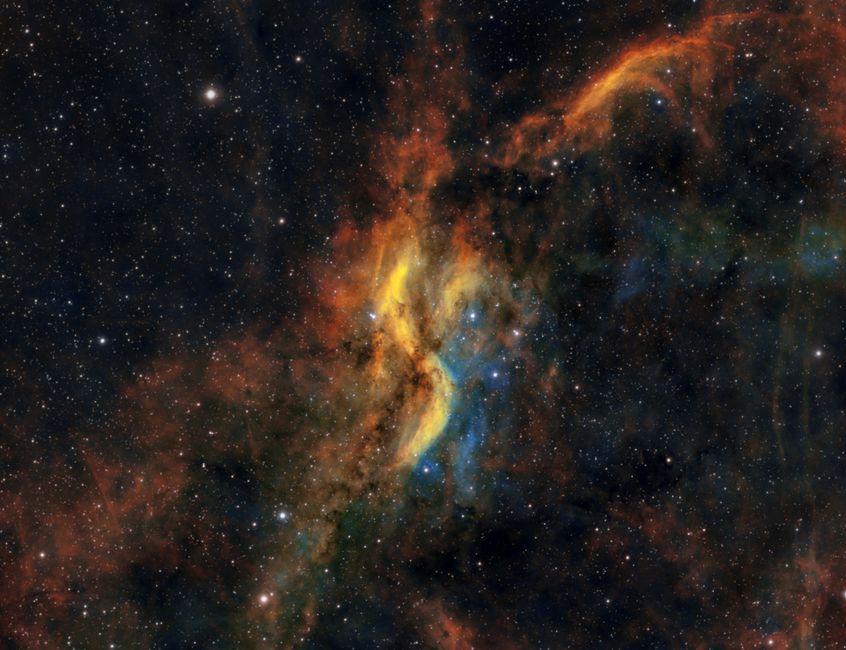
Image: Pexels via Pexels.
The briefing
A Warwick led team has identified the first documented green star, a cool white dwarf called WD J1330+6435 about 280 light years away in Draco. The color is chemistry, not temperature. Rocky debris from its own planetary system has loaded its dense atmosphere with sodium, and that sodium swallows the orange part of its light, leaving a chartreuse glow, according to lead author Mark Hollands in reporting by Reuters and The Debrief.
Why it matters
Star color has been treated as a thermometer for more than a century, and this work shows dense stellar remnants break that rule in systematic ways. The same method that found the green star also produced pink, purple, yellow, and cyan white dwarfs, and it turns a routine spectrum into a direct read on what a dead planetary system was made of.
Key details
- The study appeared in RAS Techniques and Instruments on October 14, 2026. The team ran measured spectra through a model of human color vision to calculate how each star would look to an eye, since no white dwarf is close or bright enough for its color to be judged directly, according to the University of Warwick account carried by Phys.org.
- WD J1330+6435 sits at roughly 4,000 degrees Celsius and carries calcium, lithium, and sodium from accreted rocky material. In its ultradense atmosphere, helium atoms constantly collide with the sodium and broaden its absorption across yellow, orange, and red wavelengths, both Phys.org and Reuters reported.
- Hollands told The Debrief that standing on a nearby planet under this star would feel like something out of science fiction, and Warwick colleague Boris Gansicke noted the wider sample still averages out to white.
- Of 151 white dwarfs within about 65 light years of Earth, five showed unusual colors, which the team reads as roughly one in 30 white dwarfs shining with an odd color, while the median color temperature of the sample stayed near 6,800 kelvin, according to Phys.org.
- Carbon rich white dwarfs came out pink or purple, debris polluted ones yellow, and cooler hydrogen and helium mixtures cyan. The team also flagged WD J1011+2845, just 48 light years away, as possibly the reddest star recorded, glowing deep salmon pink from carbon dredged up from its core.
Reporting from The Debrief, Phys.org, Reuters. Full stories at the sources below.
Read at The Debrief Read at Phys.org Read at Reuters