The Navy Pours Another $150 Million Into a Fighter Drone That Skips the Runway
From the CosmechBytes archive. This brief ran before the desk went UAP-only in October 2026, when coverage was broader. It stays up for the record; current briefs live in Brief Bytes.
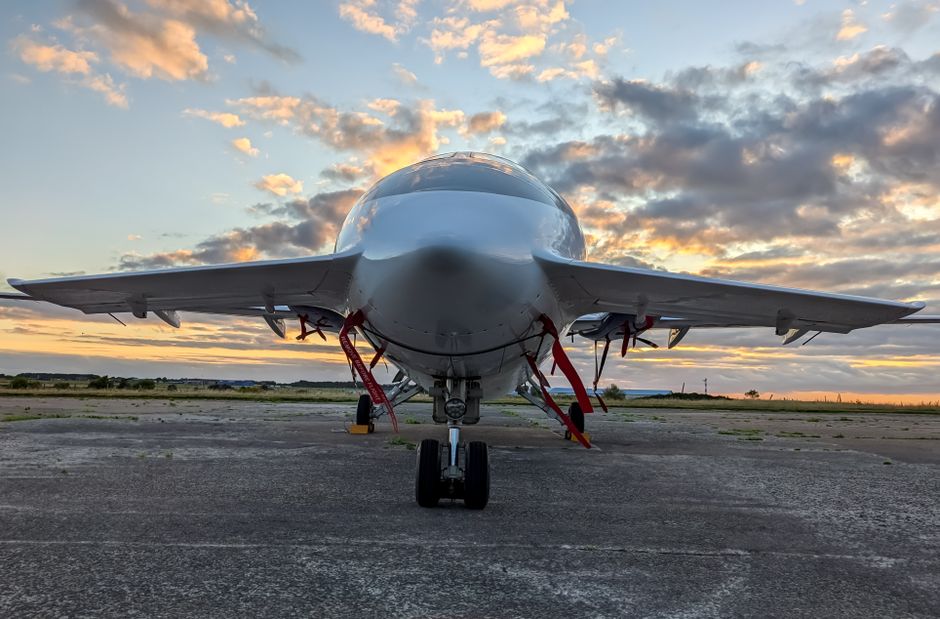
Image: Pexels via Pexels.
The briefing
The Navy has added $150 million to its agreement with Shield AI for the X-BAT, an AI piloted fighter sized drone designed to take off and land vertically from a tail sitting position with no runway or catapult needed. The company is matching the award with $150 million of its own money, bringing total announced public and private commitments to $400 million. The first full scale prototype is due by the end of October, with vertical takeoff and landing trials planned before year end.
Why it matters
If X-BAT works, the Navy could launch combat aircraft from amphibious ships, expeditionary sea bases and rough fields without displacing crewed fighters from carrier decks, multiplying the number of air wings it can put to sea. The target of an early operational capability in 2029 is extraordinarily ambitious, and everything rides on proving vertical flight physics that has defeated every previous attempt at this scale. A win here rewrites how naval airpower distributes itself across the Pacific.
Key details
- On October 8 the Navy modified an Other Transaction agreement to provide $150 million through the Defense Exportability Features program, matched by $150 million of Shield AI's own capital. Combined with the August $50 million Navy plus Defense Innovation Unit award and Shield AI's earlier match, total announced commitments reached $400 million.
- The Navy funding flows through the Office of the Under Secretary of War for Acquisition and Sustainment and is released as Shield AI hits developmental milestones.
- The plan is to finish the first of two full scale prototypes by the end of October, then begin flight testing late in 2026 with vertical takeoff and landing work, the key risk reduction step.
- The test sequence runs from engine runs with the vehicle horizontal on its trailer, to vertical engine runs, to tethered tests hanging from one of the world's biggest cranes being set up in Kansas, and only then untethered flights.
- Propulsion is a General Electric F110 engine paired with an axisymmetric vectoring exhaust nozzle originally built in the 1990s for an experimental thrust vectoring F-16 and stored for decades. The nozzle handles pitch and yaw, with bleed air routed through wing thrusters controlling roll.
- Stated specs include a maximum range around 2,000 nautical miles, a service ceiling of about 50,000 feet, internal weapons bays roughly the size of the F-35's, and two external hardpoints plumbed for drop tanks or buddy refueling stores.
- X-Forge 2 at Newton City-County Airport in Kansas will be the main flight testing hub and sustainment center, while X-Forge 3 in Des Moines, Washington is being built as the production site.
- Shield AI's Armor Harris told The War Zone the goal is a fully missionized flight in 2028 and series production in 2029, with the Runway Independent Maritime Expeditionary Strike program structured toward an early operational capability that year.
- The operating concept pairs each aircraft one to one with a self propelled launch and recovery vehicle, prepositioned across islands and ships for lily pad operations. Harris likened the dispersed survivability to mobile missile launchers that are hard to find because they never sit still.
Was this helpful?
Reporting from The War Zone, Defense One. Full stories at the sources below.
Read at The War Zone Read at Defense OneGet Briefs by email
One tight email with the week's most important Brief Bytes on UAP and aliens. Read it in five minutes, know what mattered.