Octopus intelligence may trace to an ancient rewiring of their DNA
From the CosmechBytes archive. This brief ran before the desk went UAP-only in October 2026, when coverage was broader. It stays up for the record; current briefs live in Brief Bytes.
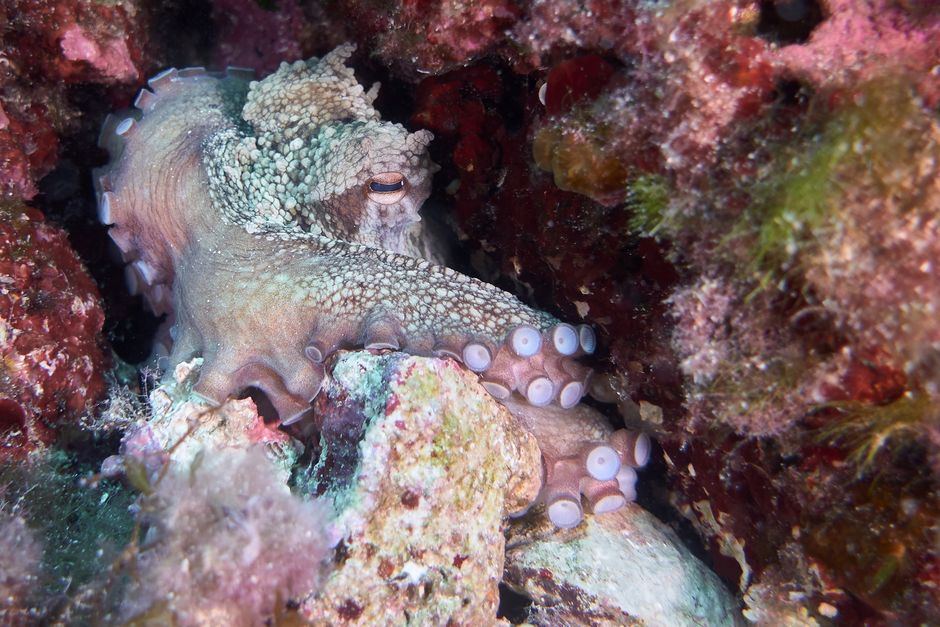
Image: Berthold Grünhagen via Pexels.
The briefing
A study from University of Vienna researchers led by Dr. Thea Rogers, published in Nature Communications on October 9, proposes that cephalopods built their elaborate nervous systems not through new genes alone but through the three dimensional folding of their DNA. Hundreds of millions of years ago, the team found, the cephalopod ancestor's genome underwent a massive burst of reorganization that brought distant stretches of DNA into contact, creating new regulatory interactions. The researchers call the resulting effect regulatory entanglement, a way for genomes to experiment with novel patterns of gene activity while keeping essential functions intact.
Why it matters
This is the first evidence that a major animal lineage evolved its most demanding traits through genome architecture itself rather than changes to individual genes, and it opens the question of whether similar reshufflings seeded complexity elsewhere in the tree of life. For the convergent evolution question the theory matters too: cephalopods developed a second, radically different kind of intelligence from vertebrates, and if regulatory entanglement proves general, the same mechanism could in principle generate complex nervous systems on entirely independent paths. That is what makes the finding resonant beyond the lab: intelligence on Earth already arose more than once, through more than one route.
Key details
- The Vienna team reconstructed the 3D organization of the genome across octopuses, squid and cuttlefish, combining chromosome structure data with gene activity measures, according to both reports.
- When DNA regions are thrown into new contact, the study found, they can begin to interact and influence each other's activity, and over evolutionary time these interactions become embedded as increasingly interconnected regulatory networks.
- Large structural units called chromatin domains stayed stable across hundreds of millions of years, while finer scale chromatin loops were highly dynamic, varying across species, tissues and developmental stages, and clustering near genes tied to the nervous system, according to both reports.
- "The genome isn't just a sequence of genes. It's folded into a complex three-dimensional structure," Dr. Rogers told Phys.org.
- The authors argue the 3D organization of DNA actively shapes how evolution unfolds, challenging the long standing assumption that genome architecture is merely a passive byproduct of selection.
- The study's authors note the principles could apply beyond cephalopods, to other lineages that underwent large scale genome rearrangements, including early vertebrate genome duplications, according to Scienmag.
Was this helpful?
Reporting from Phys.org, Scienmag. Full stories at the sources below.
Read at Phys.org Read at ScienmagGet Briefs by email
One tight email with the week's most important Brief Bytes on UAP and aliens. Read it in five minutes, know what mattered.